
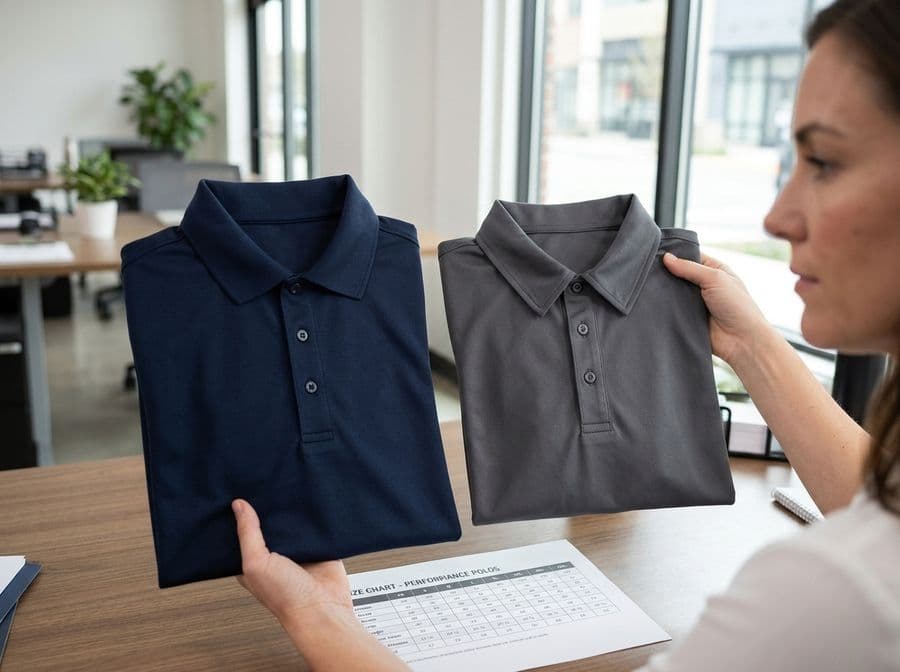
Custom polo shirts, no minimum. Order one embroidered polo with your logo, or the whole team.
You will not be pushed up to a dozen first.
Who orders one shirt first
An office manager gets told to find shirts for the front desk. A marketing coordinator needs three to wear at a trade show. A franchise owner wants to see one before ordering for every location.
Often the plan is a few shirts now and thirty later. The first few check how the logo sits. No minimum makes that test possible.
What the price is
Other suppliers handle the one-time cost of preparing a logo for embroidery in two ways. Some charge it as its own line. Others fold it into the shirt price. That cost is one reason many shops set a minimum.
The product page shows the price at each quantity. Check the quantity price ladder before you order. Small runs cost more per shirt than large ones. The ladder shows you where yours falls.
What a test order should settle
Four questions. A shirt in your hands answers each one, and a screen does not.
Does the logo sit where you expected? On a flat mockup the logo looks centered. On a fitted polo it can land high against the collar or crowd the placket. Put the shirt on someone.
Does the thread match your logo? A pique polo has a raised texture. Thread on that surface can read differently than the swatch you approved under office lights. Take the shirt to a window.
Does it fit the people who will wear it? Fabric weight is stated in ounces. A lighter pique drapes and breathes differently than a heavier one. Someone in a customer-facing job will wear it all shift. A giveaway shirt may be worn a few times. Judge fit against that.
Does the logo hold up in the wash? Wash the test shirt as you will wash the rest, within its care label. Do it before you approve the full run. Fraying at the edge of the design shows up there. So does a puckered ring around it. A sample bag will not show either.
How wide a left-chest logo can be
A polo chest is not an open field. The collar seam sits above the logo. The placket runs down the center, and the sleeve seam closes in from the side. That leaves roughly 4 inches of width for a left-chest design.
A wide wordmark has to be scaled down to fit. The letters get smaller as it shrinks. If your logo is a long horizontal name, ask to see the narrowed version first. Sometimes a stacked version of the logo is the better answer. A sleeve can carry the full-width one.
What sits behind the stitches
Pique stretches. Embroidery needs a stabilizer behind it. Without one, the needle holes can pull the weave into small puckers. The design can then drift out of shape as the fabric moves.
You cannot judge this from a photograph. Turn the washed test shirt inside out and look at the back of the design. Check that the fabric lies flat around the logo.
Before you place the full run
Keep four things from the test order:
- The shirt style and color.
- The thread color numbers you approved.
- The stitch file name for your logo.
- The order number.
When you order again for new hires or a second location, send those. They say exactly which shirt and thread you asked for last time.
Without them, a reorder starts as a guess.
When the test shirt passes, the full order is a matter of quantity and sizes. Start with the polos at custom polo shirts. Read how the stitching is done on the embroidered polo shirts page. Or go straight to all products.
By Michael Monfared, Polo Supply Co.