
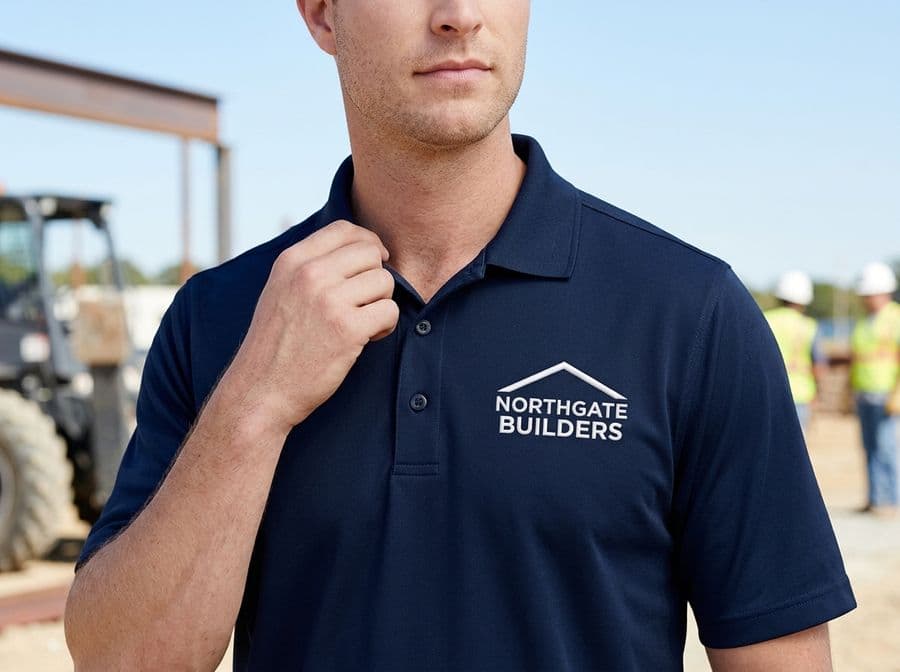
Embroidered polo shirts with your logo, and no minimum. Here is what to check before the run is sewn.
Digitizing is where the result is decided
A logo goes to a digitizer before it goes to a machine. A skilled digitizer turns your artwork into a stitch file. That file sets the path the needle takes. It uses tight columns of thread for letters and wider fill for solid areas. It also sets how dense the underlay is on your fabric.
A pique polo has a raised, textured surface. Its stitch file differs from one for a flat woven dress shirt. Pique needs enough underlay to bridge that texture. With too little, the logo can sink into the weave. Its edges then lose definition.
Ask to see a proof before the run is sewn. Check the logo's size and placement on it. How the stitches sit on pique shows only on a sewn shirt.
Thread
Embroidery thread is usually polyester or rayon. Rayon has a soft sheen on the surface. Under hot industrial washing and chlorine, it can lose strength. Polyester tends to hold up better there. Running a uniform through weekly commercial laundry? Ask which thread your order is sewn with.
Many logos work well in 4 to 7 thread colors. More colors means more needle changes, which adds time and cost. Embroidery has no true gradient. A skilled digitizer can fake one with adjacent color blocks.
Placement
Left chest is standard. The logo's center usually lands 3 to 4 inches below the left shoulder seam. That keeps it clear of the collar and the placket. It is the spot that faces a customer across a counter.
Right chest is the name drop position. Pairing a company logo with names? Logo left and name right is the convention.
A full back, a sleeve or the yoke can carry a logo too. They suit a full uniform look or a team kit. A full back carries many more stitches than a chest logo. The per-piece cost reflects that.
What a logo needs to embroider well
Text under about 0.25 inches tall is hard to hold on pique. Needle and thread have a resolution limit. Have fine text below that size? The digitizer can suggest a larger size or simpler text.
Thin lines and hairlines have the same constraint. A 1-point rule in your vector file becomes a single row of stitches. Up close it reads. From across a room it can vanish.
If your artwork has these elements, order one shirt first. A sewn sample shows how the logo will really look.
No minimum
On a single shirt, setup has fewer pieces to spread across. That is why one shirt costs more each than a 48-piece run.
Want to check the digitizing and placement first? Order one shirt, check it, then order the rest.
No minimum. One embroidered polo or the whole crew, priced on the product page.
For fabric and fit choices across the category: Custom polo shirts.
For company polo programs, and the records to keep for a reorder: Corporate polo shirts.
By Michael Monfared, Polo Supply Co.